


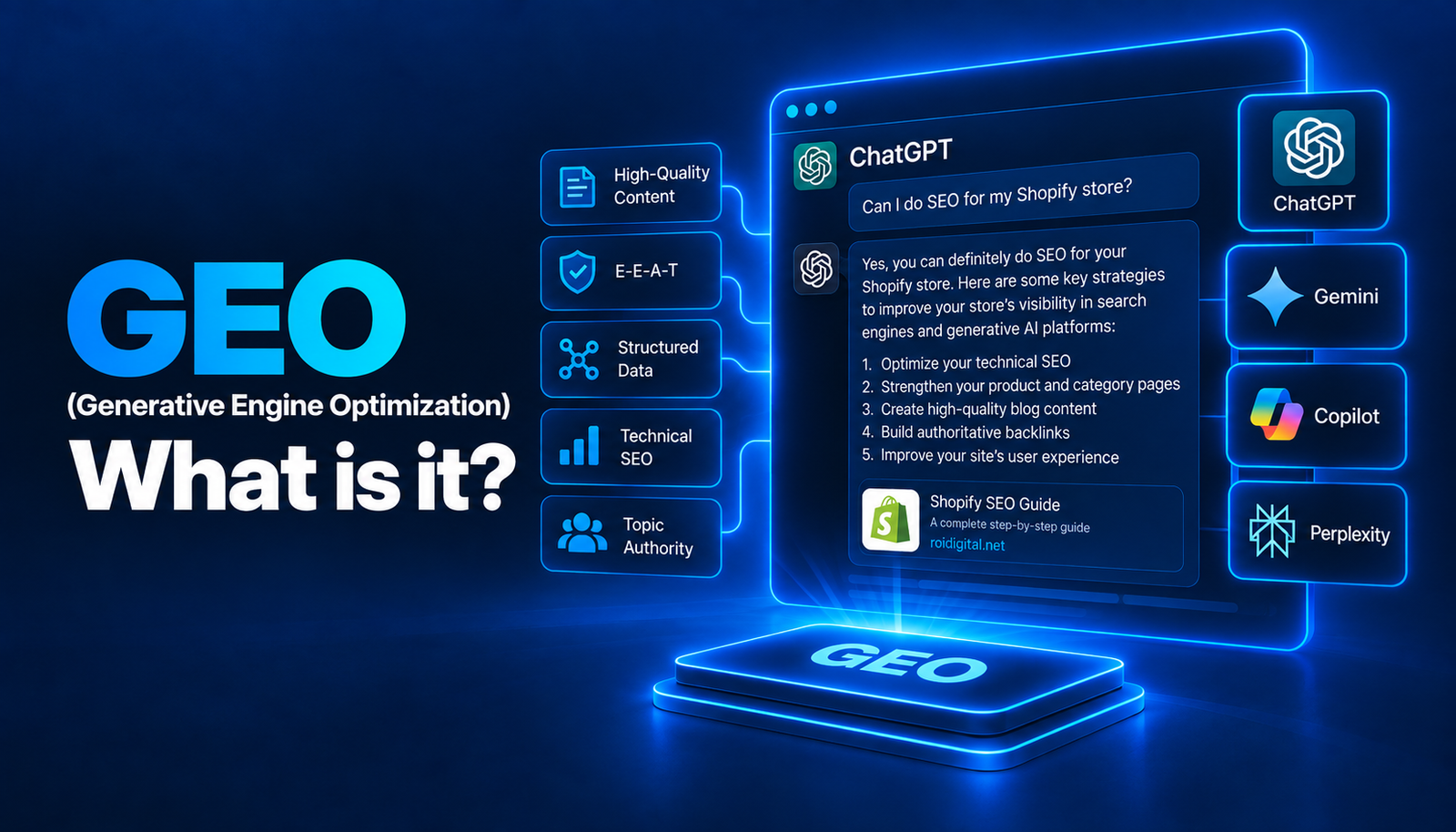

GEO stands for Generative Engine Optimization and refers to optimization efforts aimed at making content easier for AI-powered search and answer systems such as ChatGPT, Gemini, Copilot, Perplexity, and similar platforms to understand, evaluate, and use as a source when relevant.
While traditional SEO primarily focuses on gaining visibility in search engines such as Google, GEO also addresses new search behaviors in which users look for information through AI systems. Instead of typing only a few keywords, users may now ask longer questions, request comparisons, or directly ask for recommendations based on a specific need.
For this reason, simply using keywords is not enough for GEO. Content needs to explain the subject clearly, provide reliable information, answer user questions directly, and build strong topical depth around a specific subject.
GEO should not be considered a completely separate system that replaces SEO. Existing SEO elements such as technical SEO, content quality, site authority, internal linking, and user experience remain important for GEO as well.
What Is GEO?
GEO is an optimization approach designed to make web content more suitable for the way generative AI systems collect information and create answers.
When a user asks a question about a specific topic on ChatGPT, Gemini, or Perplexity, the system may generate a direct answer instead of simply presenting a list of links like a traditional search engine.
The method used to generate this answer can vary by platform. Some systems may rely on their training data, while others may perform live web searches for certain queries and gather information from current online sources.
The purpose of GEO is to make a brand or website easier to understand and more trustworthy within this information ecosystem.
For example, instead of an e-commerce agency creating only a Shopify service page, producing comprehensive content about Shopify setup, Shopify SEO, theme selection, product page optimization, and Merchant Center integration can create a stronger information structure around the topic.
This structure can support both traditional SEO and GEO.
GEO: How Do AI-Powered Searches Work?
AI-powered search systems can work differently from traditional search engines.
In traditional search, a user enters a query and the search engine ranks web pages related to that query. In AI-powered search, the system attempts to understand what the user wants to learn and may combine information from different sources to generate a direct answer.
Large language models, natural language processing technologies, search systems, and, in some cases, live web sources may all be used together in this process.
For example, instead of asking “How do I do Shopify SEO?”, a user may ask a more natural question such as “How can I improve the Google visibility of my newly launched Shopify store?”
The AI system may understand that the question is not only about the keyword Shopify, but also covers multiple related topics such as technical SEO, product pages, category structure, site speed, and content strategy.
Large Language Models (LLMs)
Large language models are AI models trained on very large amounts of text data.
These systems learn relationships between words, concepts, and topics, allowing them to generate answers to questions in natural language.
Systems such as ChatGPT, Gemini, and Copilot are built around large language models.
LLM-based systems do not necessarily evaluate a web page only through specific keywords. They may also understand the overall context of the content, the relationships between topics, and how well the content answers the user’s question.
For this reason, GEO content should not be created based only on keyword density.
The content should provide a clear answer to a specific question and explain the important subtopics in a natural structure.
Natural Language Processing (NLP)
Natural Language Processing is the general term for technologies that help computers understand, analyze, and process human language.
NLP allows AI systems to better understand user intent, entities, and relationships between concepts within a query.
For example, instead of searching for “best Shopify agency,” a user may ask, “I want professional help to improve the conversion rate of my Shopify store.”
Although the two queries use different words, the underlying user need may be similar.
From a GEO perspective, this makes it increasingly important to create content based on real user questions rather than focusing only on short keywords.
Differences Between SEO and GEO
SEO and GEO focus on different aspects of the same broader goal: digital visibility.
The main objective of SEO is to ensure that web pages can be crawled and indexed by search engines and gain visibility for relevant queries.
GEO focuses on making content easier for generative AI systems to understand and turning it into a strong source that may be used when generating answers for relevant queries.
In SEO, metrics such as ranking positions, organic traffic, click-through rate, and conversions are relatively easy to measure.
With GEO, new visibility indicators become important, such as how frequently a brand is mentioned in AI-generated answers, which topics the brand is associated with, and which pages are cited or referenced as sources.
However, the two areas are not separate from each other.
A website that is technically inaccessible, slow, or has low-quality content may also be at a disadvantage from a GEO perspective.
For this reason, a strong SEO foundation is the starting point for GEO.
The main difference between SEO and GEO is the environment in which visibility occurs. SEO focuses on traditional search results, while GEO also considers visibility within AI-generated answers.
Why Is E-E-A-T So Important for GEO?
E-E-A-T stands for Experience, Expertise, Authoritativeness, and Trustworthiness.
These concepts can be understood as practical experience, expertise, authority, and trust.
E-E-A-T is not a single standalone ranking score. However, it provides an important framework for evaluating the quality and reliability of content.
E-E-A-T becomes especially important for GEO because AI systems need to avoid providing users with incorrect or unreliable information.
Including author information, real experience, transparent sources, and up-to-date information can strengthen the credibility of content.
For example, an agency creating content about technical SEO can go beyond basic definitions by sharing real crawl examples, implementation methods, and observations from its own area of expertise.
This approach makes the content more original instead of simply repeating general information already available online.
How to Apply E-E-A-T Specifically for GEO
From a GEO perspective, the first step in applying E-E-A-T is making it clear who created the content.
Author profiles, areas of expertise, and information about real experience can help users understand who is responsible for the content.
Second, the content should include verifiable information.
When sharing research, statistics, or technical information, primary and reliable sources should be used whenever possible.
Original insights based on the brand’s own experience are also valuable.
For example, when creating content about conversion optimization, a Shopify agency can go beyond general advice and discuss real problems encountered in projects and the methods used to solve them.
Keeping content up to date is also important.
In rapidly changing industries such as artificial intelligence, advertising technology, and e-commerce, information that was accurate several years ago may no longer be valid.
Consistency across contact information, the About page, expert profiles, and service pages is also important for overall trustworthiness.
How Is GEO Done?
GEO requires broader content planning than traditional keyword research alone.
The first step is to identify the questions users may ask about the brand or industry.
These questions should not be limited to Google keywords. Longer and more detailed questions that users might naturally ask an AI system should also be considered.
Main topics and related subtopics can then be identified.
For example, under the broader topic of Shopify, supporting content can be created around Shopify SEO, theme selection, product page optimization, blog SEO, Merchant Center, and conversion optimization.
When creating content, questions should be answered as directly as possible.
Instead of unnecessarily extending the introduction, the key information the user is looking for should be provided early in the content.
Heading structure is also important. The H1 can define the main topic, H2 headings can cover major subtopics, and H3 headings can address more detailed questions.
Internal linking should connect related content. This helps both users and search systems understand how comprehensively the website covers a specific subject.
Creating original content is especially important for GEO.
Instead of rewriting existing online information using different words, brands can add original experiences, proprietary data, comparisons, tables, and practical examples.
Technical infrastructure should not be ignored.
Pages should be crawlable and indexable, canonical tags should be used correctly, and the website should be mobile-friendly, fast, and supported by a clean site architecture.
Optimization for ChatGPT, Gemini, Copilot, and Perplexity
Each AI platform does not collect information and generate answers in exactly the same way. For this reason, building strong content and technical foundations is a more sustainable approach than looking for platform-specific shortcuts.
For ChatGPT, clear and comprehensive content that directly answers user questions is important. In cases where web search is used, current and accessible sources may be considered during the answer-generation process.
Because Gemini is closely connected to the Google ecosystem, traditional SEO fundamentals remain important. Content that search engines can understand correctly and that is current and genuinely useful provides a stronger foundation.
For Microsoft Copilot, Bing visibility should also be considered. This means ensuring that the website can be crawled and indexed properly by Bing.
Perplexity is one of the AI search systems that prominently displays source links in its answers. For this reason, reliable content that answers specific questions clearly and comprehensively can be valuable for source visibility.
The common factor across all platforms is content that provides real value to users.
The purpose of GEO is not to manipulate AI systems, but to become one of the clearest, most trustworthy, and most useful sources available online for a particular topic.
A successful GEO strategy therefore requires SEO, strong content, topical authority, technical quality, and trustworthiness to work together.