

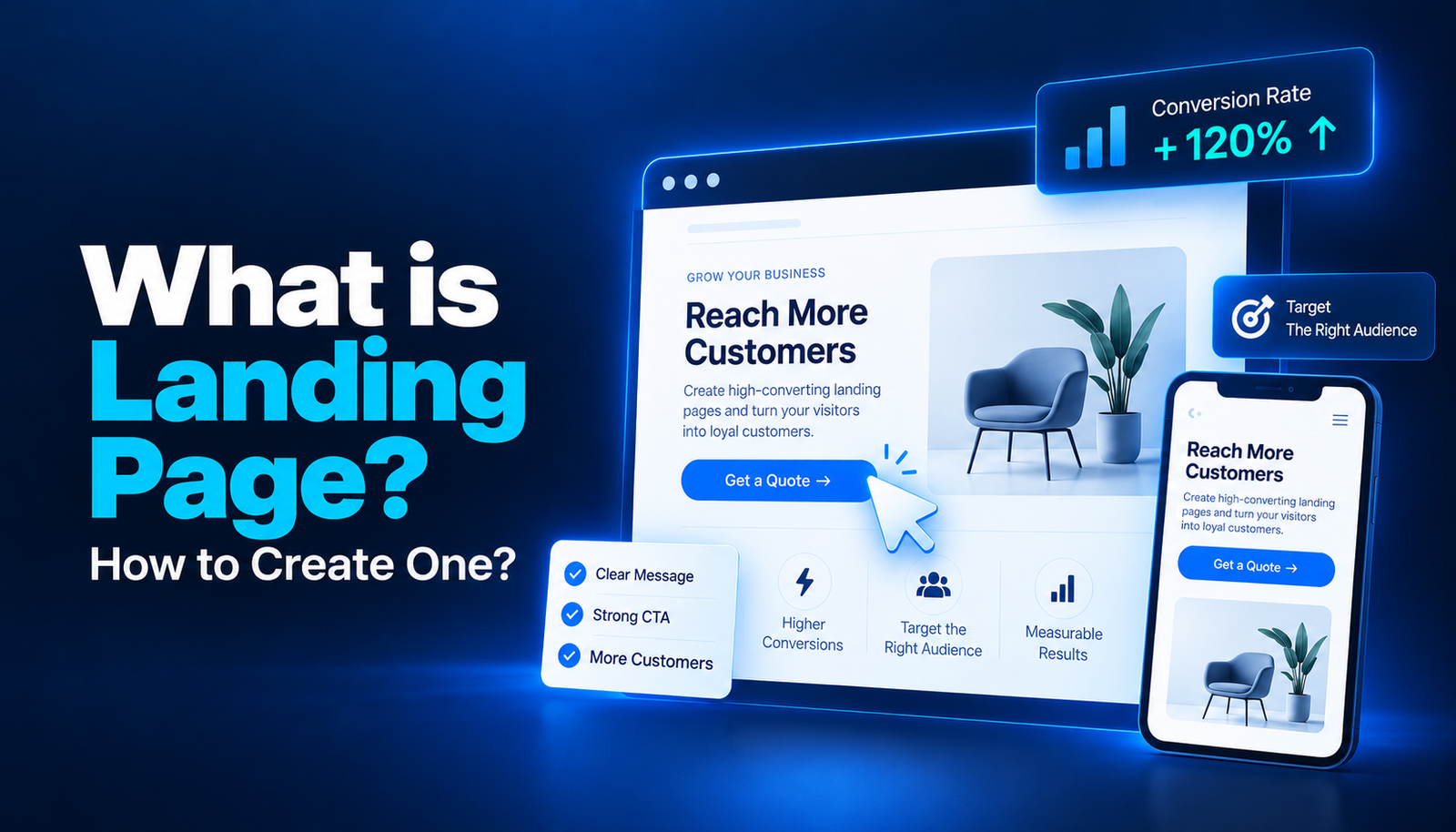

A landing page is a dedicated page created for a specific campaign, product, service, or conversion goal. Users usually arrive on this page through an ad, email, social media post, or search result, and the main purpose of the page is to guide visitors toward a specific action.
This action may involve making a purchase, filling out a form, requesting a quote, requesting a demo, signing up, or contacting the business by phone. For this reason, landing page design should minimize distractions, clarify the message, and direct users toward one primary objective.
A well-designed landing page can directly influence the performance of advertising campaigns. If users see strong consistency between the message they saw in the ad and the content they encounter on the page, the likelihood of conversion may increase.
What Is a Landing Page?
A landing page is a page users reach after interacting with a specific marketing campaign and is designed around one primary conversion goal.
On a regular website page, users may navigate to different menus, services, or content. A landing page, on the other hand, aims to offer as few choices as possible so visitors can focus on the intended action.
For example, if you are running a Google Ads campaign for a web design service, it may be more effective to send users to a dedicated landing page that explains the web design service, shows references, and includes a quote request form instead of directing them to the general homepage.
The structure of a landing page can vary depending on the campaign, but it usually includes a strong headline, a short description, key benefits, social proof, and a clear CTA.
What Is a Landing Page Used For?
A landing page is used to direct advertising and marketing traffic toward a specific conversion goal.
Providing users with one main message instead of too many choices can make the decision-making process easier.
For example, an e-commerce campaign may use a dedicated landing page for a specific product category. In the service industry, users may be encouraged to fill out a quote request form.
A landing page also makes campaign performance easier to analyze. It becomes easier to measure how many forms, sales, or registrations are generated by each traffic source.
For this reason, a landing page is not only a design element but also an important part of performance marketing.
What Are the Types of Landing Pages?
Landing page types can vary depending on the campaign objective and the action expected from the user.
The most commonly used landing page types include:
- Lead generation pages
- Product sales pages
- Service quote pages
- Campaign and discount pages
- Webinar or event registration pages
- Free trial or demo pages
- App download pages
- E-book or guide download pages
Each type of landing page may have a different structure. For example, a lead generation page may focus on a short form and benefit-driven content, while a product sales page may place more emphasis on product advantages, pricing, and customer reviews.
What Is the Difference Between a Homepage and a Landing Page?
The main difference between a homepage and a landing page is their purpose.
A homepage is the general digital entry point for a brand. From there, users can navigate to services, products, blog content, and contact pages.
A landing page, however, is created for a single campaign or conversion goal. As a result, it usually contains fewer links and a more focused user journey.
While a homepage provides broader information about the brand, a landing page presents a specific offer to the user.
For example, a homepage may showcase different services such as SEO, Google Ads, Shopify, and web design. However, for a user coming from a Google Ads campaign, a dedicated landing page focused only on Google Ads services may be more appropriate.
This structure increases consistency between the advertising message and the landing page.
What Are the Advantages of Creating an Effective Landing Page?
Well-designed landing pages can improve advertising performance, simplify the user experience, and make conversion data easier to analyze accurately.
It Can Improve Conversion Rates
The primary purpose of a landing page is to guide users toward one specific goal.
When unnecessary menus, irrelevant content, and too many action options are reduced, users may find it easier to make a decision.
A well-aligned headline, description, CTA, and form structure can support conversion performance.
Especially for paid advertising traffic, it is important that the message on the landing page closely matches the ad copy.
It Helps You Understand Your Target Audience
Landing page performance can be used to understand what your target audience is interested in.
You can analyze which headlines generate more conversions, which offers attract more attention, and which traffic sources bring higher-quality users.
This data can provide valuable insights when preparing future campaigns.
For example, if a landing page emphasizing price advantages converts better, your audience may be highly price-sensitive. If references and success stories perform better, trust signals may be more important.
It Is Easier to Analyze
Because landing pages are built around a single objective, their performance can be measured more clearly.
Metrics such as page views, form submissions, CTA clicks, purchases, and conversion rates can be tracked directly.
A/B tests can be used to compare different versions of headlines, visuals, or CTAs.
This makes the optimization process more systematic.
Tips for Creating a Successful Landing Page
When creating a successful landing page, the experience should be as clear and simple as possible for the user.
Key points to consider include:
- The headline should immediately explain what the offer is
- The subheading should reinforce the benefit provided to the user
- The CTA button should be visible and easy to understand
- The form should be kept as short as possible
- The ad message and landing page content should be consistent
- Mobile design should always be tested
- The page should load quickly
- Unnecessary menus and links should be reduced
- Social proof should be included
- References and customer reviews should be added
- Trust signals should be clearly visible
- The benefits of the offer should be explained clearly
- Users should understand why they should take action now
- Unnecessarily long text should be avoided
- CTAs can be repeated at strategic points throughout the page
When preparing a landing page, the user’s perspective should remain the priority. Information that seems obvious to the brand may not always be obvious to the visitor.
For this reason, when users arrive on the page, they should be able to understand within a few seconds what is being offered, why it matters, and what the next step is.
How Can You Drive Traffic to Your Landing Pages?
Landing page performance depends not only on the quality of the page but also on directing the right users to it.
The following channels can be used to drive traffic to a landing page:
- Google Ads search campaigns
- Meta Ads
- LinkedIn Ads
- YouTube advertising
- Email marketing campaigns
- Remarketing campaigns
- Organic SEO
- Social media posts
- Influencer and UGC campaigns
- Affiliate campaigns
In search campaigns such as Google Ads, users are actively researching a need, so landing page traffic may have higher intent.
With Meta Ads, there should be strong visual and message consistency between the ad creative and the landing page.
Remarketing campaigns can be used to reconnect with users who have previously visited the website through dedicated landing pages.
In email marketing campaigns, different landing pages can be created for different customer segments.
The most effective approach is usually not to send all traffic to a single page, but to create landing pages tailored to the campaign and target audience.
A well-designed landing page can help advertising campaigns not only attract more traffic, but also convert a higher percentage of existing traffic into customers.